Understanding Open-Source Models • Beginner⏱️ 15 min read
What Open-Source Models Are Changing
What Are Open Source Models Changing?
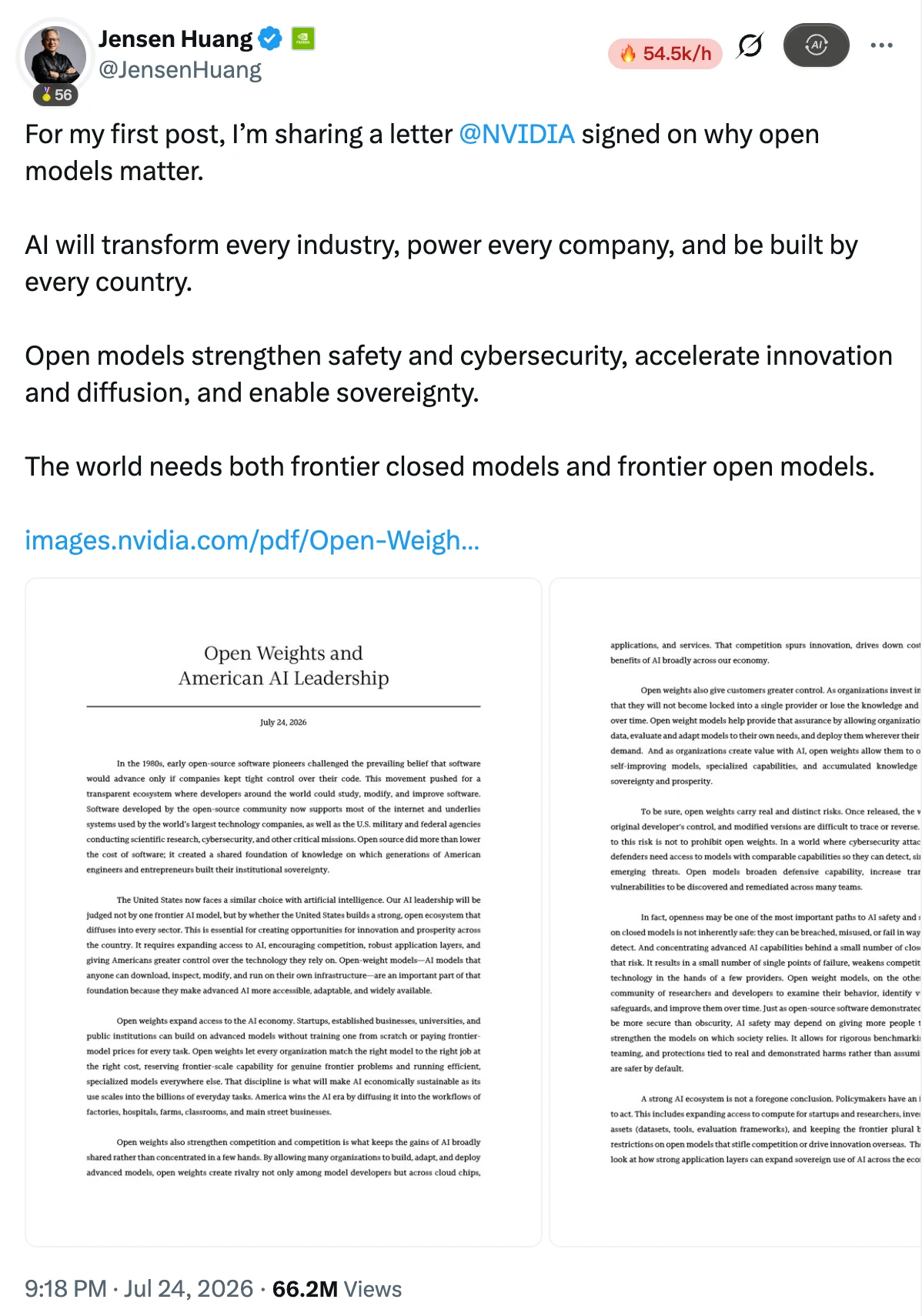
You might not have expected it, but Nvidia CEO Jensen Huang made his first post on X, and it was dedicated to open source.
On July 24, 2026, he shared an open letter signed by Nvidia, discussing why open models matter:
This world needs both cutting-edge closed-source models and cutting-edge open models.
Many people may have grown accustomed to opening a chat window, sending a question, and waiting for the AI to respond. But when you start using AI to process company data over the long term or integrate internal systems, you might encounter the following issues: Is the data secure when sent out? What if the service suddenly rate-limits? Can the model learn how your company processes data?
Open source models offer another solution to these problems. You can download the model within the scope permitted by the license, deploy it in your own environment, continue fine-tuning it, and let users decide how to use it.
Of course, the debate between open source and closed source for large models has always been a topic of endless discussion. Jensen Huang's letter once again resonated with us, and we decided to partner with several co-builders to start this journey of practical open source model applications in a purple handbook. This time, we bring you practical open source model application content. May open source models thrive!
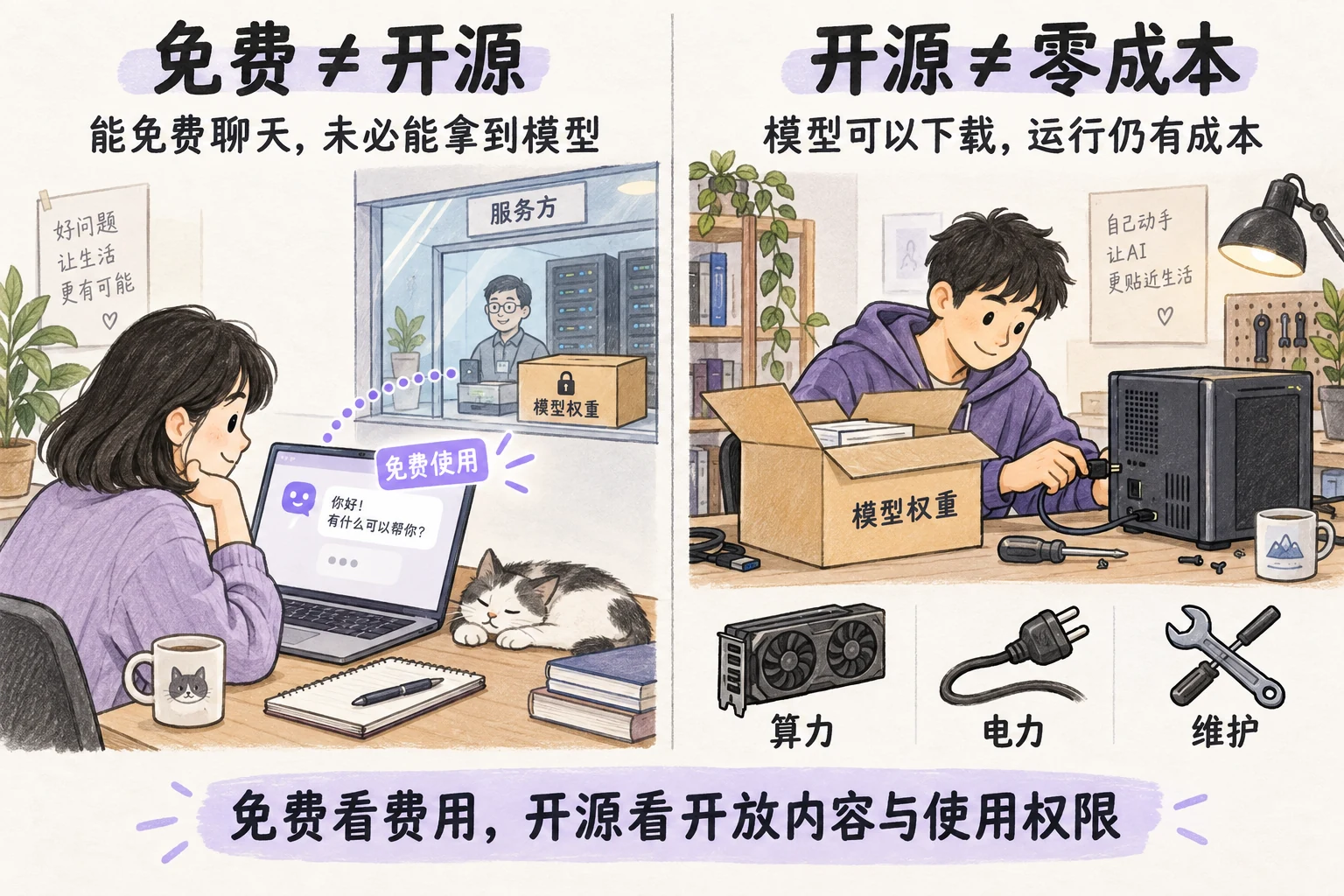
Remember, free doesn't necessarily mean open source, and open source doesn't necessarily mean free?
When chatting with AI on a website or querying a model through an API, the model is usually run by the model provider. You submit input, and the provider returns results. You generally don't need to worry about how the server is configured or how the model is maintained.
Open source models offer another option, allowing you to obtain the model parameters after training, commonly known as weights. With appropriate software and hardware, these parameters can run on your computer, server, or private cloud. Questions that previously needed to be sent to external services can now be processed in your own environment.
There are two things here that are easily confused.
"Free" refers to whether you need to pay; "open source" refers to what you can obtain and how you are allowed to use it. A chat product can be free without providing model weights. A model that is free to download still requires computing power and maintenance costs to run.
An API is simply a way to access models. Open source models can be hosted by service providers and delivered to you via APIs. Models you deploy yourself can also be made available to colleagues through internal APIs. Therefore, "open source vs. closed source" and "calling APIs vs. self-deployment" should be considered separately.
In daily discussions, people often collectively refer to models whose weights can be downloaded as open source models. We will also follow this common convention in subsequent chapters.
However, when making strict distinctions, we will clarify that open weights do not equal open source for the entire model training process. Training data, training code, and usage permissions still need to be examined separately.
All called open source, but what is open varies~
After obtaining a model, you're probably curious about how it was trained.
This is where the differences between different models become apparent. Some allow you to download and run them without disclosing complete training materials. Others go further by providing training code and data descriptions, allowing external developers to study the model's training trajectory.
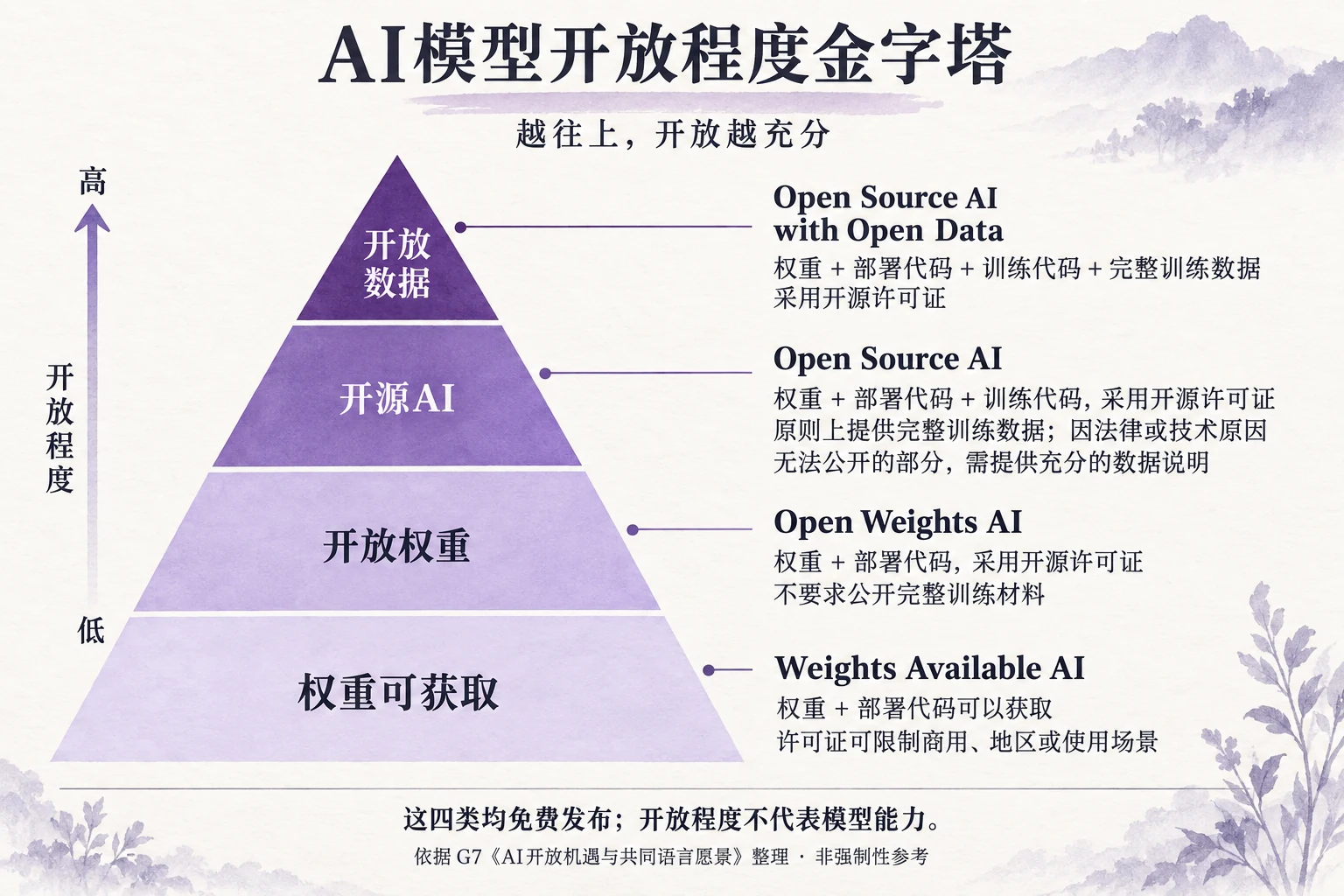
In May 2026, the G7 published a common reference document on AI openness, categorizing these differences into four types, from highest to lowest openness:
Even complete training data is public. Model weights, deployment code, training code, and complete training data are all provided under open source licenses, corresponding to Open Source AI with Open Data.
Weights and code are public, with restricted data explained in detail. Corresponding to Open Source AI. Complete training data should in principle be provided; parts that cannot be shared due to legal or technical reasons need to be adequately replaced with data documentation.
A trained model is given to you to run and modify. Corresponding to Open Weights AI, providing weights and deployment code under open source licenses, but not necessarily disclosing complete training materials.
Downloadable, but with additional conditions when using. Corresponding to Weights Available AI, where weights and deployment code can be obtained, but licenses may restrict commercial use, usage regions, or specific scenarios.
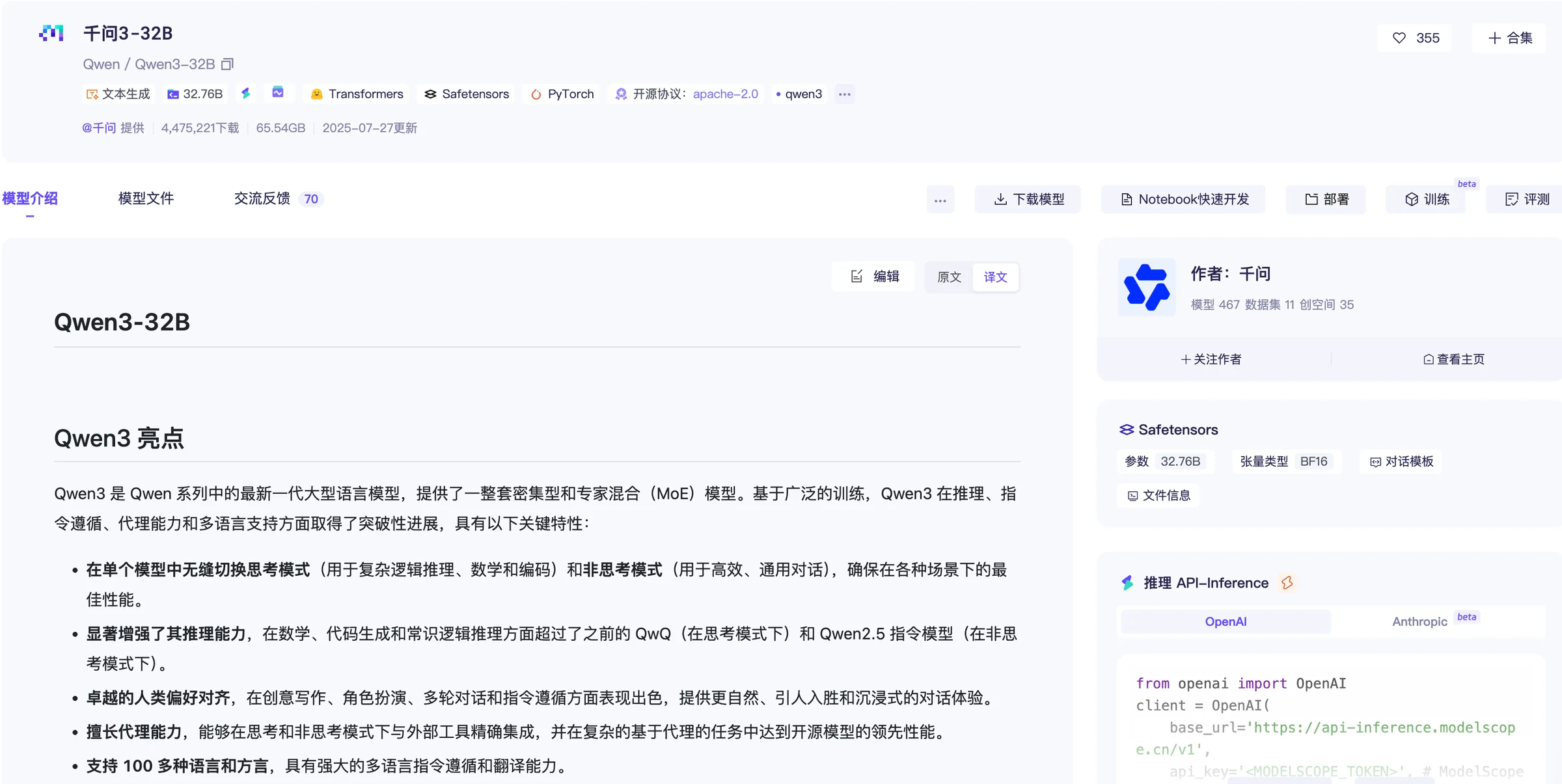
Taking Qwen3 as an example, the official team provides open weights models along with instructions for local running, deployment, quantization, and fine-tuning. Developers can use tools like Transformers, vLLM, SGLang to run models, and can also use fine-tuning tools to continue training. Based on the above distinctions, this demonstrates the practical value of the open weights tier.
Most enterprises don't need to redo large model pre-training — being able to run existing models, adapt them to your own devices, and fine-tune with business samples can already solve many specific business problems.
Can open source models really rival closed source models?
Being able to deploy models yourself is great, but if the model frequently makes errors in business scenarios, it's hard to entrust real work to it.
In the past, open source models gave many people the impression that they were convenient for research but fell short of the strongest closed-source models. With the continuous update of model capabilities, this assessment needs to be reconsidered.
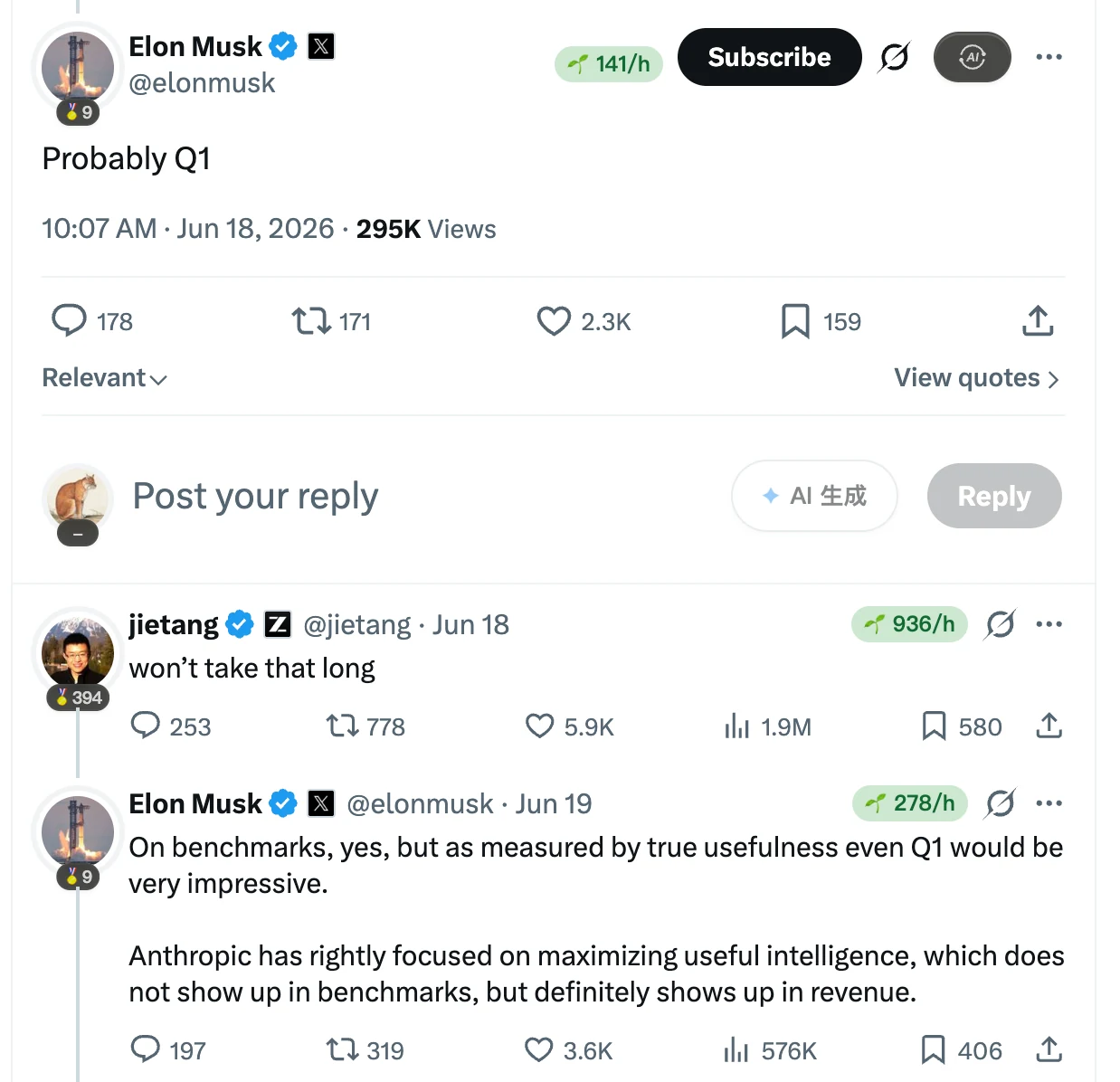
On June 18, 2026, there was an interesting interaction on X. Netizens were discussing when Chinese models could reach the level of Anthropic's frontier models, and Elon Musk predicted it might take until the first quarter of 2027. Zhipu co-founder Tang Jie replied below with "won't take that long."
Whether the two predictions will come true remains to be seen based on subsequent model performance. The fascinating aspect of this discussion is that open source models have already reached the frontier of the entire large model landscape.
A security incident disclosed by Hugging Face in July 2026 once again demonstrated the importance of open source models.
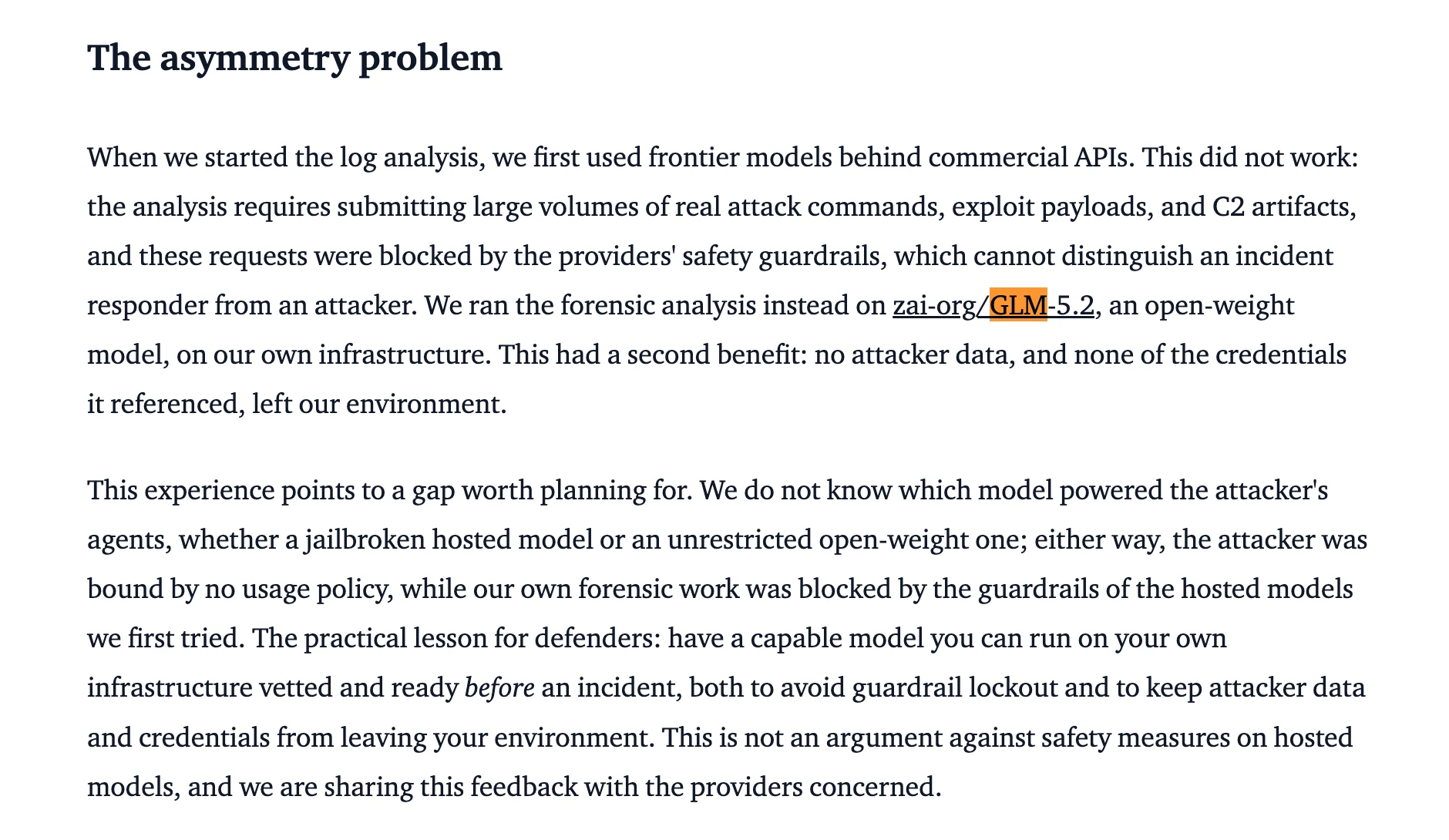
Part of Hugging Face's production infrastructure was compromised, and the security team needed to analyze a large number of attack records to understand what the attackers had done, which credentials they had touched, and where the impact had reached. The HF team first tried using frontier models through commercial APIs but encountered an awkward problem. The real attack commands and exploit content used for investigation triggered the service provider's security restrictions, and the analysis requests were blocked.
Subsequently, the team used the open weights model GLM-5.2 on their own infrastructure to conduct forensic analysis, allowing the investigation to continue. The related attack data and credentials also remained in the internal environment.
In the subsequent technical review, Hugging Face further explained that the team reconstructed approximately 17,600 attack actions and used open weights models including GLM-5.2 to interpret obfuscated and encrypted attack payloads.
This incident demonstrated the importance of open source models.
Using open source models is not subject to closed-source restrictions. We can keep data local, use them offline, and make task execution more controllable.
What scenarios are more suitable for locally deploying open source models?
Vertical domains are also an important application direction for open source models. General large models learn from vast amounts of public data, but their understanding of enterprise-internal device names, business processes, industry terminology, and specialized knowledge may still be limited. Through fine-tuning on vertical domain data, the model can further learn this specialized knowledge.
For tasks that need to process sensitive data, local deployment also has advantages. Models can perform inference within the enterprise's internal network and connect with existing knowledge bases, databases, and business systems, thereby reducing the need to send sensitive data to external services.
However, not all tasks require locally deployed open source models.
For tasks with fewer model invocations, rapidly changing business needs, or requiring continuous use of the latest general model capabilities, calling APIs directly is usually more convenient. For some long-term, stable, and repetitively executed business tasks, open source models have greater application potential.
For example, tasks like text classification, intent recognition, information extraction, document summarization, and knowledge base Q&A usually have relatively clear input and output formats. Enterprises can choose appropriately sized models based on task complexity and use their own business data for training or fine-tuning. For these tasks, using the largest parameter models is not necessarily required.
Remember, being able to download a model doesn't mean you can use it however you want
The model is running and performing well, but if you want to use it in commercial products or share your fine-tuned version, you still need to check the LICENSE, which is the license.
Being downloadable, commercially usable, and modifiable for redistribution are different permissions.
Generally speaking, MIT and Apache License 2.0 are relatively permissive open source licenses that allow commercial use and modification, and don't require all derivative code to be publicly released. Software using the MIT license only needs to retain copyright and license notices; Apache 2.0 specifies requirements for modification documentation, related notice retention, and NOTICE handling during redistribution, and includes clear patent grant provisions.
For example, the Qwen3 series models use Apache 2.0.
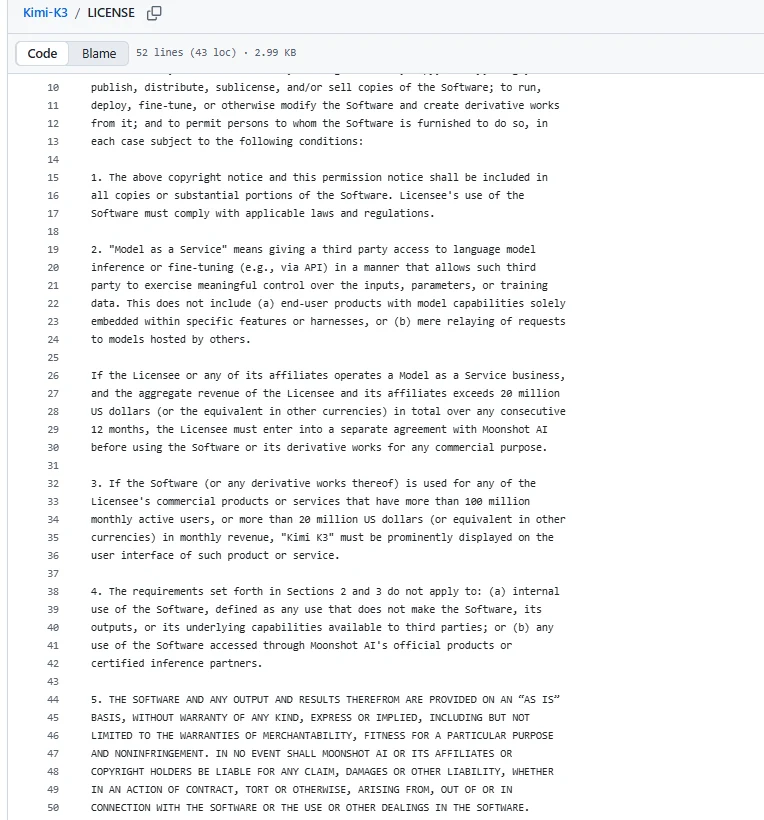
Kimi K3 has separate agreements for certain commercial uses, allowing deployment, fine-tuning, and creation of derivative works, but when model services reach a specified revenue threshold, a separate agreement is required.
DeepSeek-V3's code uses the MIT license.
Therefore, when using models, if you want to publicly release a fine-tuned model or provide it to other users, you need to re-check the original model's license to see if such use is permitted, and whether you need to retain the model name, license, and source information.
If a new model is obtained by merging multiple models, you also need to check each model's license separately to ensure their requirements don't conflict.